

• Software
  • NOVA APPLICATIONS
    Protein Modeling
  • Molecular Biology
  • Automated Virtual Cloning
  • Clone Sequence Verification
  • Gel Electrophoresis Simulation
  • Multiple Sequence Alignment
  • Pairwise Sequence Alignment
  • PCR Site-Directed Mutagenesis
  • PCR Primer Design
  • Sanger Sequence Assembly
  • Protein Analysis
  • Protein Docking
  • Protein Structure Prediction
  • Genomics
  • Clinical Research
  • De Novo Genome Assembly
  • Variant Analysis
  • Whole Genome/Whole Exome
  • Transcriptomics
  • ChIP-seq Data Analysis
  • RNA-Seq Alignment and Analysis
  • Services
  • COVID-19
  • Product Updates
  • Product Notifications
  • Educational Software Request
  • Help + Tutorials
  • About
  • Contact

QUESTIONS? CALL 866.511.5090

DOWNLOAD FREE TRIAL
SHOPPING CART
MY ACCOUNT
DNASTAR DNASTAR
  • Software
  • NOVA APPLICATIONS
    Protein Modeling
  • Molecular Biology
  • Automated Virtual Cloning
  • Clone Sequence Verification
  • Gel Electrophoresis Simulation
  • Multiple Sequence Alignment
  • Pairwise Sequence Alignment
  • PCR Site-Directed Mutagenesis
  • PCR Primer Design
  • Sanger Sequence Assembly
  • Protein Analysis
  • Protein Docking
  • Protein Structure Prediction
  • Genomics
  • Clinical Research
  • De Novo Genome Assembly
  • Variant Analysis
  • Whole Genome/Whole Exome
  • Transcriptomics
  • ChIP-seq Data Analysis
  • RNA-Seq Alignment and Analysis
  • Services
  • COVID-19
  • Product Updates
  • Product Notifications
  • Educational Software Request
  • Help + Tutorials
  • About
  • Contact

How much disk space do I need for my templated genome assembly?

How much disk space do I need for my templated genome assembly?

How much disk space do I need for my templated genome assembly?

November 24, 2015 Next-Gen Sequencing

In a previous post we described the RAM dependencies for de novo genome assemblies, which showed a linear relationship with genome size. Extrapolation for assembling large, eukaryotic genomes would suggest RAM requirements measured in terabytes, but quite often de novo assembly is not the goal. Rather, you wish to align large numbers of reads against a known reference genome in order to detect variation relative to said reference. For such applications, Lasergene Genomics Suite and SeqMan NGen use DNASTAR’s patented disk sort alignment (DSA) algorithm, greatly reducing RAM requirements. In using the DSA, the software uses disk space for temporary files required during the assembly process. The speed of the drives will impact the time of the assembly, and for maximum efficiency, we recommend having one drive for the input data and result files, and a separate drive for the temporary files.
 
The question then arises as to how much disk space will be needed for a templated assembly. Many of the same factors that impact RAM usage for de novo assembly influence the disk space requirements for a templated assembly, including: the genome size and complexity, the number of reads, the read length, and the read accuracy. The choice of an appropriate reference sequence is also critical due to the potential for misalignment, and to avoid elimination of critical sequences that cannot be aligned with confidence.
 
 
Templated Assembly Disk Requirements
 
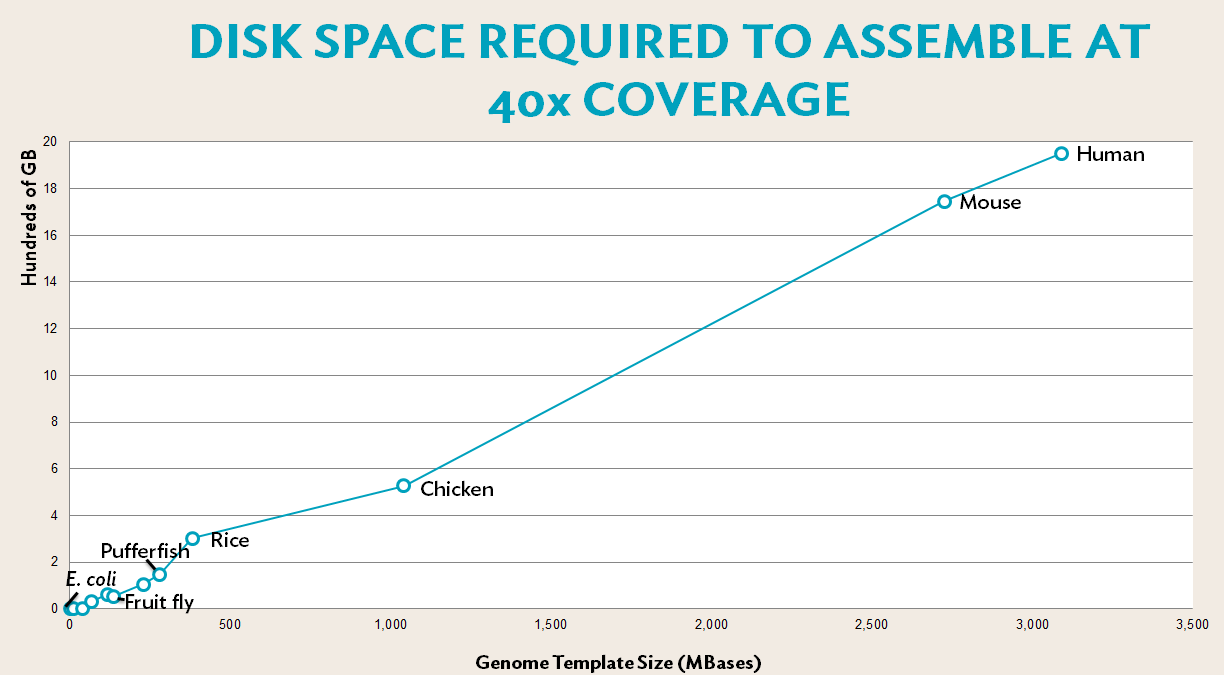
We collected sufficient Illumina 2×100 paired end data sets from the Sequence Read Archive (SRA) to provide approximately 40x coverage for a range of genome sizes from E. coli to H. sapiens. Data was assembled against the corresponding reference genomes using SeqMan NGen, monitoring the disk space utilized during the process. The measured disk space does not include input data (reads and reference genome) but it does include both temporary files and final result files. For non-microbial organisms, the graph suggests a rule of thumb of allowing about 0.5 – 0.7 GB of disk space per Mb of genome length.  As shown in the graph, a human genome can be aligned against a reference genome using SeqMan NGen on a computer having as little as 2 terabytes of hard disk space available.
 
 
Learn more about reference-guided genome assembly in Lasergene and see benchmarks for various assembly times here.
0
Share

Leave a Reply

Your email is safe with us.
Cancel Reply

Search Blog Posts

Categories

  • Blog
    • Best Practices
    • Clinical Research
    • DNASTAR Customer Stories
    • DNASTAR News
    • Newsletters
    • Next-Gen Sequencing
    • Press Releases
    • Product Notifications
    • Product Updates
    • Publications
    • Resources
    • Sequence Analysis
    • Structural Biology
    • Webinars
    • Workflows
  • featured post
  • Uncategorized

Recent Posts

  • Lasergene 17.3.3 Release Notes June 28, 2022
  • Why Structure Prediction Matters June 14, 2022
  • Expert Guided Protein Structure Prediction Webinar June 14, 2022
  • Why Structure Prediction Matters June 13, 2022
  • Why Structure Prediction Matters June 13, 2022

Tags

assembling sequences cloud Cloud Assemblies customers De Novo Assembly DNASTAR Genomics Lasergene Metagenomics Metagenomic Sequencing NCBI GenBank newsletters next-gen NGS NGS Sequence Alignment NGS Sequence Asembly publications seqbuilder pro SeqMan NGen sequence assembly Webinar

Archives

Find us on

Most Commented Posts

  • Eppley Institute Adopts DNASTAR Software By toms on March 13, 2013 0
  • Clustal Omega alignment does not complete and results in a “fatal error” message By Sharon Page on June 17, 2014 0
  • DNASTAR Lasergene Software Now Available on the Amazon Cloud By toms on September 4, 2014 0

Would you like to receive technical tips and special offers straight to your inbox?

  • About

Get a 14-Day free trial of our complete Lasergene package. Try before you buy!

FREE TRIAL DOWNLOAD

© 2026 — DNASTAR Privacy Policy

Prev Next
This website uses cookies to improve user experience and understand our web usage. By continuing to use our website, you consent to our use of cookies. Accept
Privacy & Cookies Policy

Privacy Overview

This website uses cookies to improve your experience while you navigate through the website. Out of these cookies, the cookies that are categorized as necessary are stored on your browser as they are essential for the working of basic functionalities of the website. We also use third-party cookies that help us analyze and understand how you use this website. These cookies will be stored in your browser only with your consent. You also have the option to opt-out of these cookies. But opting out of some of these cookies may have an effect on your browsing experience.
Necessary
Always Enabled

Necessary cookies are absolutely essential for the website to function properly. This category only includes cookies that ensures basic functionalities and security features of the website. These cookies do not store any personal information.

Non-necessary

Any cookies that may not be particularly necessary for the website to function and is used specifically to collect user personal data via analytics, ads, other embedded contents are termed as non-necessary cookies. It is mandatory to procure user consent prior to running these cookies on your website.